

Jasa Raharja’s four TOP GRC Awards 2026 highlight the growing role of integrated governance, risk intelligence, AI, and digital transformation in public-service organisations.
JAKARTA — The role of governance, risk management, and compliance is changing as organisations face increasingly complex regulatory, technological, and operational environments. In Indonesia’s public-service and insurance sector, PT Jasa Raharja (Persero) is among the companies highlighting this shift, after receiving four recognitions at the TOP GRC Awards 2026.
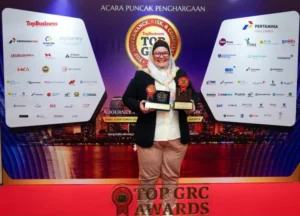
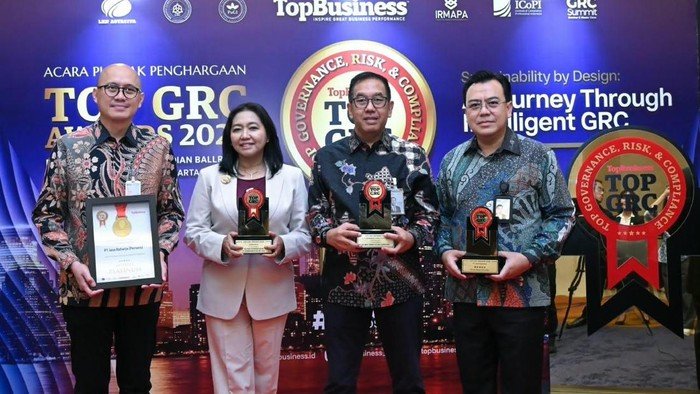
The company received the Platinum Medal, TOP GRC Awards 2026 #Star 5, The High Performing Board of Commissioners on GRC 2026, and The Most Committed GRC Leader 2026, awarded to President Director Muhammad Awaluddin. The recognitions were presented at Raffles Jakarta on September 9, 2026.
The awards are significant in the context of an industry environment where GRC is increasingly moving beyond traditional compliance functions. Organisations are now expected to connect governance and risk management with strategy, data, technology, operational resilience, and long-term value creation.

From Compliance Framework to Decision Intelligence
Jasa Raharja has positioned GRC as part of its broader organisational strategy rather than treating it solely as a regulatory requirement. The company has stated that governance, risk management, and compliance should be embedded in business processes and decision-making while supporting improvements in public services.
That approach is increasingly relevant as organisations generate larger volumes of operational data. Data that was previously used mainly for reporting can potentially become an input for early-warning systems, predictive analysis, and management decision support.
Jasa Raharja has been developing this approach through its Risk Townhall 2026, which focused on transforming governance for a sustainable and resilient future through AI, GRC, ESG, and enterprise risk management. The company said it wants to move risk management toward a Risk Intelligence model capable of generating early warnings, predictive analytics, risk insights, and decision support.
This development reflects a broader trend in risk management. Rather than responding to risks only after an incident or deviation has occurred, organisations are increasingly looking to identify patterns earlier and use data to support preventive action.
AI Adds a New Dimension to Public Protection
The transition is also visible in Jasa Raharja’s approach to artificial intelligence. In August 2026, Muhammad Awaluddin presented the company’s AI strategy at the AI Indonesia Initiative Forum, explaining that AI was being explored not only to accelerate services for accident victims but also to identify risk patterns and support accident prevention.
The company has identified several potential applications, including an AI-Based Accident Prediction and Prevention System, AI-based collection analytics, and AI-supported medical claim and fraud intelligence. These initiatives indicate how data analytics can potentially connect risk management with service delivery and prevention.
At the same time, the use of AI introduces a new layer of governance requirements. Jasa Raharja has highlighted issues including personal-data protection, cybersecurity, algorithmic bias, transparency, and human oversight. The company has emphasised that technological innovation needs to be accompanied by appropriate governance.
This is an important consideration for organisations handling sensitive information and delivering services related to public protection. The faster an organisation adopts data-driven technologies, the greater the need for controls that establish accountability and protect the interests of stakeholders.
Digital Transformation and the Insurance Ecosystem
Jasa Raharja’s GRC development is also taking place alongside a wider transformation of the insurance and public-service ecosystem. The company has described data integration and system interoperability as important elements in developing a more connected protection ecosystem involving regulators, insurers, healthcare providers, academics, and other stakeholders.
The direction is consistent with a wider evolution in financial and insurance services. Digital platforms, real-time data, embedded services, and ecosystem-based models are changing how organisations interact with customers and institutional partners.
For public-service organisations, however, digital transformation carries an additional responsibility. Service acceleration needs to be accompanied by reliability, security, transparency, and accountability. A digital process that is faster but poorly governed can create a different set of operational and reputational risks.
Jasa Raharja’s role makes this particularly relevant. The company describes itself as a state-owned social insurance company providing basic protection through mandatory passenger accident insurance and third-party liability insurance related to road traffic accidents. Its mission also includes delivering digitally integrated basic protection supported by human capital and stakeholder engagement.
Consistency as an Organisational Test
Jasa Raharja’s latest recognition also comes against a backdrop of long-term GRC consistency. The company has maintained the five-star TOP GRC recognition for eight consecutive years, from 2019 through 2026, while its High Performing Board of Commissioners on GRC recognition has continued for six consecutive years, from 2021 through 2026.
From an organisational perspective, continuity matters because GRC systems need to function beyond individual initiatives or annual assessments. Their effectiveness depends on how consistently governance structures, risk controls, compliance mechanisms, and organisational culture operate over time.
The challenge becomes more complex as risks evolve. Cybersecurity, data privacy, artificial intelligence, operational resilience, regulatory changes, and changing customer expectations require organisations to continuously reassess their risk landscape.
For that reason, the future of GRC is likely to depend increasingly on integration. Governance, risk management, compliance, technology, sustainability, and business strategy cannot always be managed as separate organisational silos.
The Global Direction of Intelligent GRC
The theme of TOP GRC Awards 2026, “Sustainability by Design: A Journey Through Intelligent GRC,” reflects this evolution. It places sustainability, governance, risk management, compliance, organisational culture, data, and technology within a connected framework.
For companies operating in highly regulated sectors, the development of intelligent GRC can offer a framework for navigating uncertainty while maintaining accountability. The objective is not simply to identify more risks, but to turn information into useful insight and enable organisations to respond more effectively.
Jasa Raharja’s experience illustrates how this transition can take place within a public-service organisation. Its current initiatives connect GRC with risk intelligence, AI, digital services, ecosystem collaboration, and public protection.
The four TOP GRC Awards 2026 therefore represent one milestone within a broader organisational journey. The longer-term measure will remain how effectively governance principles are translated into everyday decisions, how technology is governed, and how risk intelligence contributes to more resilient operations and better services.
As the global business environment becomes more data-driven and interconnected, the integration of governance, risk, compliance, and technology will remain an important consideration for organisations across sectors. Jasa Raharja’s ongoing transformation provides one Indonesian example of how that integration is being developed within a public-protection institution.