

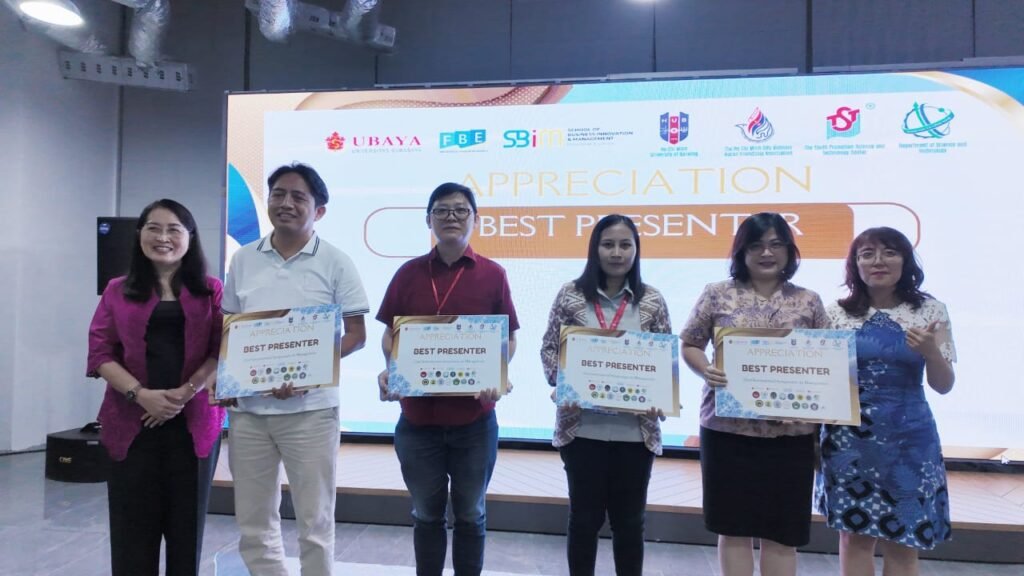
FEB UM’s awards at INSYMA 2025 in Vietnam highlight research trends spanning green marketing, circular economy, flexible work, AI and MSME digitalisation.
MALANG, Indonesia — The landscape of management research is changing as businesses confront a combination of environmental pressures, technological transformation and shifting expectations in the workplace. Recent recognition received by students and an academic from the Faculty of Economics and Business at Universitas Negeri Malang (FEB UM) in Vietnam offers a snapshot of several issues shaping that transition.
At the 22nd International Symposium on Management (INSYMA) 2025, held in Ho Chi Minh City from 12 to 15 May 2025, FEB UM representatives received multiple awards for research presentations and academic papers. The results placed research from an Indonesian university within an international forum involving academics and practitioners from different countries.
Two FEB UM master’s students, Lili Purwanitasari and Yohanes Wibisono, received Best Presenter awards. Meanwhile, FEB UM professor Wahjoedi, M.E., received two Best Paper recognitions.
The subjects addressed by the researchers illustrate how management studies are increasingly connected to broader structural changes in the global economy.
Lili Purwanitasari’s research examined green marketing and its role in driving the circular economy. Using a systematic literature review and bibliometric insights from Scopus, the study explored the development of research around the relationship between marketing and more sustainable economic models.
The growing attention to circular economy principles reflects a wider shift in how businesses consider resources, production and consumption. Instead of viewing sustainability solely as an environmental concern, companies are increasingly examining how resource efficiency and responsible business practices can be incorporated into operational and market strategies.
Another area of transformation was examined by Yohanes Wibisono, whose research focused on flexible work arrangements, job autonomy, work engagement and employee performance.
The issue has gained international relevance as organisations reconsider traditional workplace structures. The expansion of hybrid and flexible working models has created new questions for managers concerning employee autonomy, organisational culture, communication and performance measurement.
For companies, the challenge is not simply whether flexible work should be adopted. Organisations also need to understand the conditions under which flexibility can operate effectively and how management systems can maintain employee engagement and organisational performance.
Wahjoedi’s research brought the discussion closer to the development of smaller businesses. His study examined the effectiveness of training in supporting diversification and digitalisation among butterfly pea flower MSMEs in Tuban, Indonesia.
The research reflects another major trend in emerging markets: the need to help smaller enterprises adapt to digital economic conditions. Technology can expand market access and improve business processes, but adoption often depends on human capabilities, training, product development and the ability of business owners to adapt their operating models.
The combination of these research themes provides an interesting picture of the contemporary management agenda. Sustainability, workplace transformation and digitalisation may appear to be separate subjects, but they increasingly intersect within modern organisations.
INSYMA’s own agenda reflects this convergence. The 22nd edition adopted the theme “Leveraging AI to Build Competitive Advantage in Financial Industries,” placing artificial intelligence and technological innovation at the centre of discussions surrounding management and competitiveness.
Artificial intelligence is now influencing decision-making, customer services, financial operations and productivity across multiple industries. At the same time, technological adoption raises questions about skills, organisational structures, employment and the ability of smaller businesses to participate in digital markets.
International academic forums therefore play an important role in connecting these different perspectives. Research conducted in Indonesia can be examined alongside studies from other economies, allowing researchers to identify both shared trends and differences in how businesses respond to technological and economic change.
For FEB UM, the recognition in Vietnam also demonstrates the role universities can play in connecting local research with international conversations. Studies based on Indonesian businesses and communities can contribute evidence to broader discussions about sustainability, digitalisation and organisational transformation.
The longer-term significance of such recognition extends beyond the awards themselves. International presentation provides researchers with opportunities to test their arguments, receive feedback, develop professional networks and explore potential collaborations with researchers from other countries.
For the global management research community, the themes represented by FEB UM’s delegation are likely to remain important. Companies will continue to face pressure to operate more sustainably, organisations will continue to adapt to changing workplace models, and digital technologies will continue to reshape the capabilities required by businesses.
In that environment, the role of universities is increasingly connected to the ability to generate research that is both academically rigorous and relevant to real-world challenges. The experience of FEB UM in Vietnam provides one example of how research from Indonesia can participate in that wider global exchange of knowledge.