


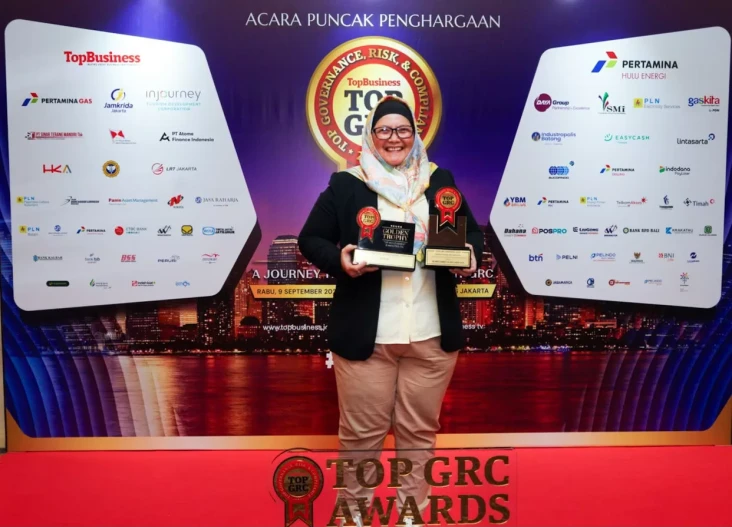
PERURI maintains a five-star GRC rating and receives the Golden Trophy at TOP GRC Awards 2026, highlighting the growing role of governance and risk management in digital transformation.
JAKARTA — As organisations accelerate digital transformation, governance is increasingly becoming inseparable from technology strategy. The challenge is no longer simply how quickly a company can adopt new technologies, but how effectively it can manage the risks, security requirements and regulatory responsibilities that accompany that transformation.
Indonesia’s PERURI is among the companies placing governance, risk management and compliance (GRC) at the centre of its transformation agenda. At the TOP GRC Awards 2026, the company once again received a five-star rating and was awarded the Golden Trophy after maintaining the highest rating over several years. The ceremony was held at Hotel Raffles Jakarta on 9 September 2026.
The recognition also extended to Farah Fitria Rahmayanti, PERURI’s Director of Technology, Information and Risk Management, who received The Most Committed GRC Leader 2026 award. Her recognition comes as PERURI continues to integrate risk management and governance into its broader corporate and technology strategy.
From Compliance Function to Strategic Framework
PERURI’s approach reflects a broader shift in corporate governance. GRC is not positioned solely as a mechanism for regulatory compliance, but as part of decision-making, risk management, business resilience and long-term transformation.
Farah said the company continues to strengthen GRC so that it becomes more closely integrated with corporate strategy and business processes. She also pointed to increasingly complex technology developments and changing risk profiles as reasons why governance needs to be adaptive, integrated and risk-based.
This perspective becomes particularly significant for technology-driven organisations. Digital transformation can improve efficiency and expand services, but it also creates new exposure involving cybersecurity, data protection, operational continuity and regulatory compliance.
For companies managing critical digital services, these risks cannot be treated as separate from innovation. Instead, risk management needs to become part of the technology development lifecycle.
Integrating Security into Digital Innovation
PERURI’s current approach includes the implementation of Security and Privacy by Design in service development. The company also integrates system-based risk management to ensure that digital innovation remains aligned with information-security standards and applicable regulations.
The principle is particularly relevant to PERURI’s role as an institution assigned to operate as GovTech Indonesia. The company is expected to work in an agile, flexible and dynamic manner in supporting the acceleration of national digital public services.
The combination of speed and control presents a structural challenge for digital transformation. Innovation requires flexibility, while public digital services require security, accountability and reliability.
PERURI’s GRC framework is therefore positioned as a mechanism for connecting these requirements. The company describes GRC as a safeguard that allows innovation to move quickly while maintaining accountability and compliance.
A Wider Digital Transformation
The GRC development is taking place alongside a broader transformation of PERURI itself. The company has expanded beyond its traditional security-printing capabilities into digital security and describes its current direction as that of a high-security technology company. PERURI states that its digital transformation began with the expansion of its core authentication capabilities into security digital solutions.
Its GovTech responsibilities further increase the importance of this transformation. In August 2026, the Ministry of Administrative and Bureaucratic Reform and PERURI discussed continued cooperation to accelerate the integration of public services and develop a sustainable government digital ecosystem. The discussion included PERURI’s role in GovTech/INA Digital and priority government digital services.
PERURI has also been involved in efforts to promote secure and integrated digital government procurement. Through the 2026 Government Procurement Forum & Expo, the company highlighted the importance of technology that is not only digital, but also aligned with user requirements, business processes and the security needs of public services.
These developments illustrate why governance is becoming increasingly relevant to the technology sector. As digital services become interconnected with government, businesses and citizens, governance frameworks must address more than internal corporate processes.
Consistency as Part of the Governance Journey
The Golden Trophy received by PERURI in 2026 also carries a different meaning from a one-time recognition. The company has previously recorded a five-star rating and The Most Committed GRC Leader recognition at the TOP GRC Awards in 2024 and 2025. Its 2026 result continues that sequence.
From a corporate management perspective, continued recognition provides a documented indication of consistency in the company’s GRC programme. PERURI says its governance practices are continuously maintained and refined rather than being implemented as a temporary initiative.
The wider implication is that digital transformation increasingly requires companies to view governance as infrastructure. Technology systems may provide the tools for transformation, but governance determines how risks, responsibilities, controls and strategic decisions are managed around those tools.
For PERURI, this relationship is particularly important because its transformation combines digital technology, security requirements and public-sector responsibilities. The company’s GRC strategy is therefore developing alongside its broader role in Indonesia’s digital ecosystem.
As digital transformation continues to reshape industries worldwide, the PERURI case demonstrates how governance, risk management and compliance can be integrated with technology strategy rather than treated as a separate corporate function.
The continued challenge will be maintaining that balance as technologies evolve, digital services expand and risk environments become more complex. For high-security technology organisations, sustainable transformation increasingly depends not only on the ability to innovate, but also on the ability to build systems that make innovation accountable, secure and resilient.