
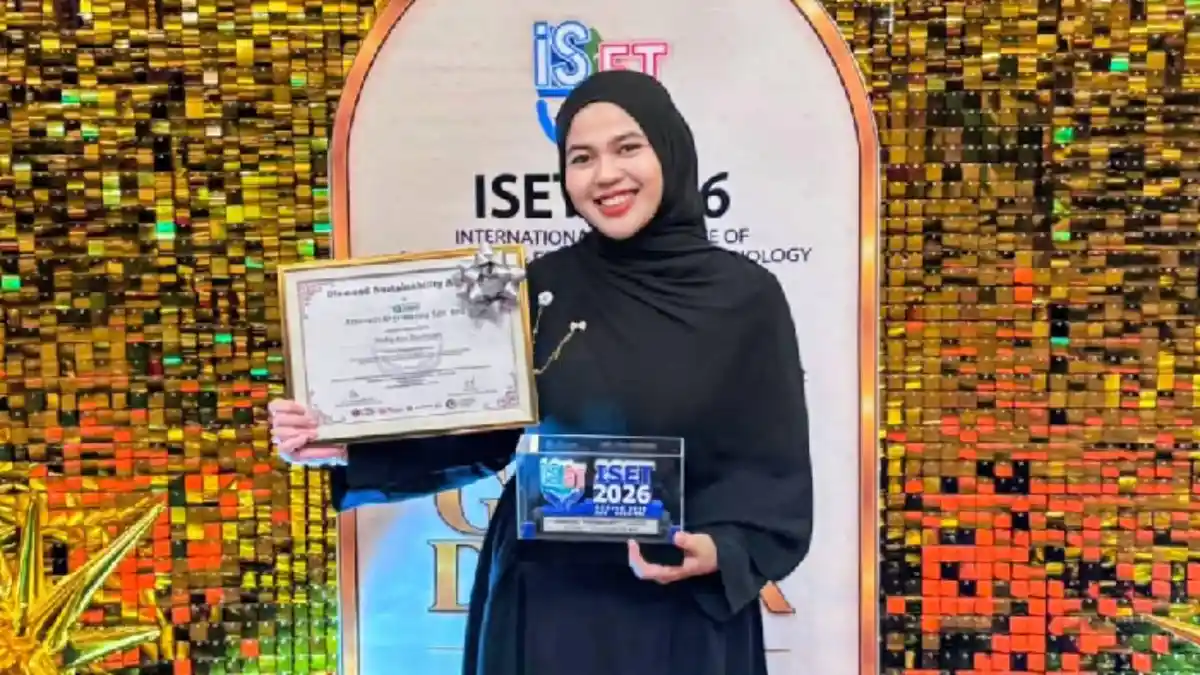
Wafiq Alni Dzulhijjah’s award-winning research on Sigupai rice husk highlights how agricultural waste can become advanced materials for sustainable and environmental technology.
An agricultural residue from Aceh, Indonesia, is becoming part of a much larger scientific conversation about how waste can be transformed into valuable resources.
Researcher Wafiq Alni Dzulhijjah has attracted international attention through research using rice husk from the locally known Sigupai variety as a raw material for advanced materials and membrane technology. Her work represents a growing global research direction: finding ways to extract greater technological value from agricultural by-products while reducing their environmental burden.
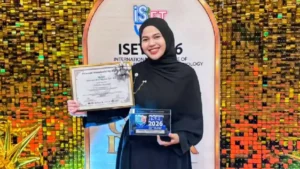
Wafiq received the Diamond Sustainability Award 2026 after presenting her research at the International Conference of Sustainable and Environmental Technology 2026 (ISET 2026), held in Johor Bahru, Malaysia, on 22–24 September 2026. The conference was organized alongside the Regional Conference on Environmental Engineering 2026–AUN/SEED-Net.
The research focuses on utilizing Sigupai rice husk for the development of advanced membrane technology, particularly thin-film nanocomposite membranes. The approach places a common agricultural residue within a field that intersects materials science, environmental engineering and water-treatment technology.
A Global Shift in How Waste Is Viewed
Rice husk is one of the many agricultural residues increasingly being examined by scientists as a potential source of higher-value materials.
A 2025 review published in Sustainable Chemistry for Climate Action describes rice biomass valorization as an important area within the circular economy. Researchers are exploring technologies that can convert rice husk and rice straw into bio-based products, energy, materials and environmental applications. The same review also identifies cost-effectiveness, feedstock variability and process integration as continuing challenges for large-scale industrial adoption.
Another 2025 review in Heliyon highlights the growing interest in rice husk as a feedstock for silica and silicon production. Its abundance and material composition make rice husk an increasingly studied source for advanced-material applications.
The significance of Wafiq’s work can therefore be understood within this broader scientific movement. The research does not simply ask how agricultural waste can be disposed of. It asks whether that material can be processed into something with significantly greater technological value.
The Potential Inside Sigupai Rice Husk
Sigupai provides a distinctive local dimension to the research.
Research published in Case Studies in Chemical and Environmental Engineering examined the synthesis and characterization of nanosilica derived specifically from Sigupai rice husk waste. The study demonstrates the potential of this local rice residue as a source of nanosilica and examines how processing conditions affect the resulting material.
This direction is important because nanosilica is not merely another form of agricultural waste. It is a functional material that can become an ingredient in various technological applications.
Further research has also explored nanocellulose derived from Sigupai rice husk. Together, nanosilica and nanocellulose represent two examples of how a single agricultural residue can become a starting point for different material-development pathways.
The research is also connected to thin-film nanocomposite membrane technology. Studies involving rice-husk-derived nanosilica and nanocellulose have examined their potential as antifouling agents in membranes, linking agricultural waste utilization with water-treatment technology.
This connection is particularly significant because water security is increasingly associated with technological innovation. Membrane systems are used in water and wastewater treatment, while researchers continue to investigate ways of improving membrane performance, durability and resistance to fouling.
From Laboratory Research to Real-World Impact
The global interest in agricultural waste valorization is not limited to laboratories.
Across different parts of Asia, agricultural residues are being examined as feedstock for new products, energy systems and materials. In ASEAN, regional initiatives have specifically identified agricultural and food waste as both an environmental challenge and an opportunity for circular-economy development.
A recent ASEAN-focused initiative, for example, has highlighted opportunities for SMEs and start-ups to transform agricultural by-products into commercially useful products. Rice straw and other residues have been explored for packaging and other applications, illustrating how agricultural waste can become part of new value chains.
Research into rice husk has also expanded into energy-related applications. An ASEAN energy initiative recently highlighted the potential of rice husks as a source of carbon and silica for advanced materials, including research connected to energy-storage technologies.
These developments point toward an increasingly important global principle: the future of sustainability may depend not only on reducing waste, but also on redesigning production systems so that waste streams become inputs for new processes.
Why the Sigupai Story Matters
The story of Sigupai rice husk offers a useful example of how global technological questions can emerge from highly local resources.
Aceh has its own agricultural varieties, environmental conditions and resource characteristics. Research that begins with those local conditions can generate scientific knowledge that may eventually be compared with, adapted to or combined with research from other regions.
For Wafiq, the international recognition in Malaysia provides visibility for that research journey. It also demonstrates how researchers working with locally available materials can participate in international scientific forums.
However, an international award should not be confused with commercial readiness. Moving a material from laboratory-scale research toward industrial application requires further technical validation, reliable feedstock supply, process optimization, economic analysis, environmental assessment and scale-up.
Those challenges are well recognized across the broader field of agricultural waste valorization. Recent scientific reviews note that the transition from promising laboratory results to economically viable large-scale processes remains one of the key issues facing the sector.
That distinction is important. The value of research is not determined solely by whether a technology has already reached mass commercialization. Scientific research can also establish the material characteristics, processing pathways and technical evidence needed for future development.
A Local Resource in a Global Research Landscape
Wafiq’s research illustrates how the boundaries between agriculture, materials science and environmental engineering are becoming increasingly interconnected.
A rice husk can begin its life as an agricultural by-product. Through scientific processing, it can become a source of nanosilica or nanocellulose. Those materials can then be investigated for applications in advanced membranes and other technologies.
The process represents a shift from a linear model—produce, consume and discard—toward a more circular approach in which materials are recovered and redirected into new value chains.
For countries with significant agricultural production, this approach could have broader implications. The availability of biomass residues provides a potentially large resource base, although each application still needs to be evaluated according to technical feasibility, economic viability and environmental performance.
The international recognition received by Wafiq therefore offers more than an individual achievement. It provides visibility for a research approach that connects local agricultural resources with global priorities in sustainable technology.
From the rice fields of Aceh Barat Daya to an international scientific forum in Malaysia, the Sigupai story reflects an increasingly global question: what if materials traditionally considered waste could become part of the next generation of sustainable technologies?
The answer will depend on continued research, collaboration and rigorous validation. But the direction is already clear. Agricultural residues are no longer being viewed only as disposal problems. Increasingly, they are being investigated as potential resources for a circular and technology-driven economy.