

Indonesian student Griselda Nuria Alisha earns international recognition in Malaysia with DJOGOSURO, combining local wisdom, digital technology and volcanic disaster education.
An educational innovation developed by an Indonesian high school student has brought a local approach to volcanic disaster preparedness onto an international stage, demonstrating how cultural heritage and digital technology can be combined to address real-world challenges.
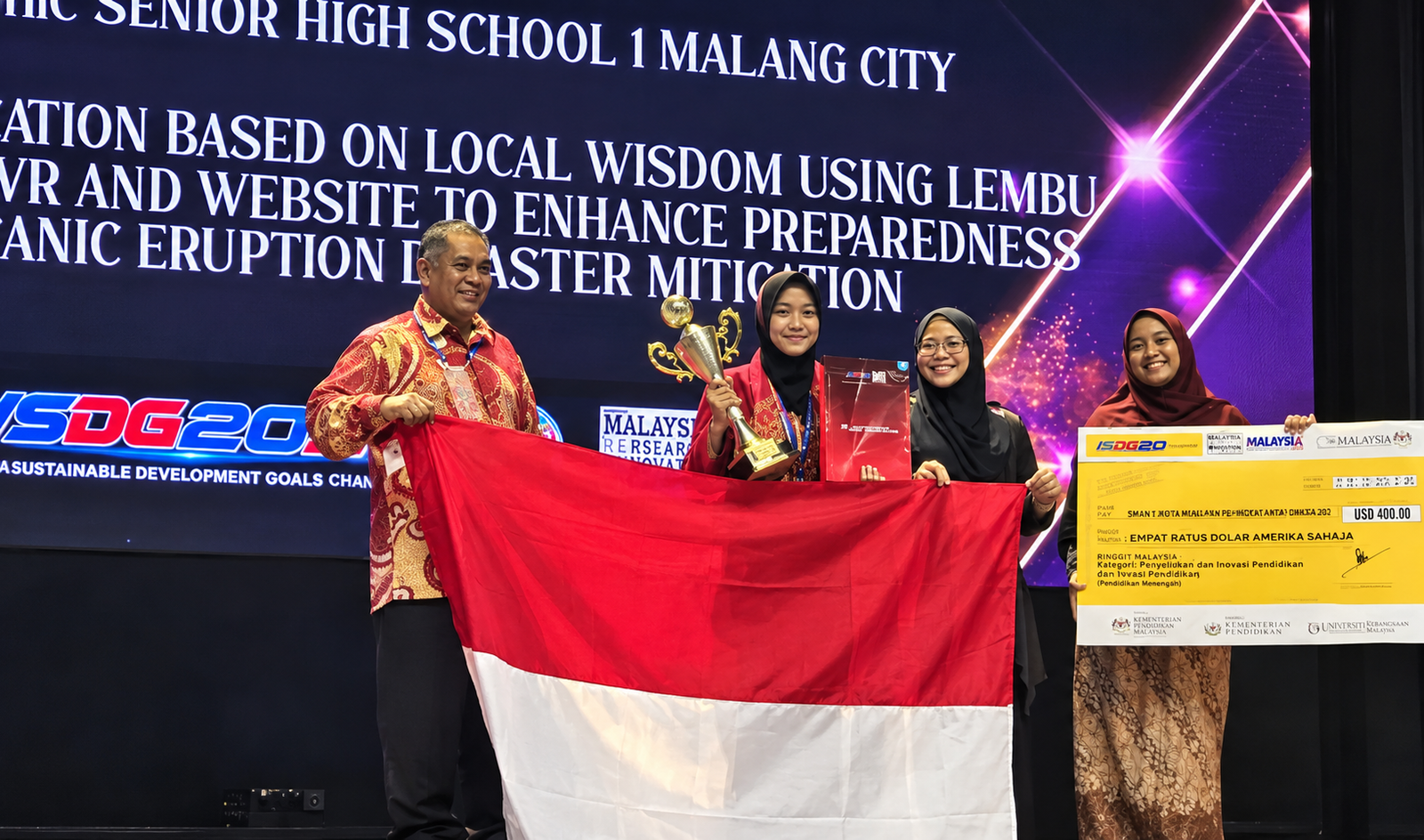
Griselda Nuria Alisha, a Grade 12 student at MAN 1 Kota Malang in East Java, Indonesia, received the MMU President’s Excellence Award – 2nd Runner-Up at the World Sustainable Development Goals Challenge (WSDG) 2026 in Malaysia.
Her project, titled “DJOGOSURO: Education Based on Local Wisdom Using Lembu Suro Cinematic VR and Website to Enhance Preparedness for Volcanic Eruption Disaster Mitigation,” uses the cultural heritage of Lembu Suro as an entry point for teaching volcanic disaster preparedness through digital media. (timesindonesia.co.id)
The achievement came as the global education sector continues to explore ways of making learning more interactive, accessible and relevant to challenges outside the classroom. DJOGOSURO illustrates one possible model: instead of separating technology, culture and environmental education, the project places them within a single learning experience.
Turning Local Heritage into Digital Education
Lembu Suro is associated with local traditions and stories surrounding communities near Mount Kelud, one of Indonesia’s active volcanoes. For communities living in volcanic regions, however, disaster preparedness is not simply an academic subject. It is connected to everyday awareness and the ability to respond when volcanic activity changes.
DJOGOSURO seeks to make that knowledge more accessible to younger audiences by incorporating Lembu Suro into a digital educational platform. The project combines Cinematic Virtual Reality with a website containing educational materials, animation, quizzes and information about volcanic activity.
The concept reflects a broader movement in education toward experiential and technology-supported learning. Virtual and interactive tools can help students visualize situations that are difficult to reproduce in traditional classroom settings.
For disaster education, this can be particularly relevant. Students may understand the definition of a volcanic eruption through a textbook, but interactive visualization can provide another way to understand risk, preparedness and appropriate responses.
A Model with Broader Global Relevance
Although DJOGOSURO originates from a specific Indonesian cultural context, the underlying challenge is global. Communities across different parts of the world live with natural hazards, from volcanic eruptions and earthquakes to floods, storms and wildfires.
The United Nations has repeatedly emphasized the importance of strengthening disaster resilience and ensuring that communities have access to knowledge and preparedness measures. In this context, education represents one of the long-term tools for reducing vulnerability.
The project therefore offers a useful example of how local knowledge can be connected with broader resilience objectives. Instead of applying a completely standardized model, educational content can be adapted to the cultural environment of the community where it is being used.
That principle can potentially be applied beyond Indonesia. A similar approach could allow schools in other disaster-prone regions to incorporate their own cultural narratives, local knowledge and community experience into digital learning tools.
From School Project to International Recognition
The WSDG 2026 competition provided Griselda with an opportunity to present DJOGOSURO beyond Indonesia. The event was held at Multimedia University in Cyberjaya, Malaysia, from September 24 to 28, 2026.
The international award ceremony took place on September 26 at Tun Chancellor Hall. Griselda received the MMU President’s Excellence Award – 2nd Runner-Up, together with a trophy, medal and RM850 prize. According to the award information reported by TIMES Indonesia, the recognition highlighted creativity, innovation, dedication and commitment to solutions aligned with the Sustainable Development Goals. (timesindonesia.co.id)
The competition also provided an international environment where student projects could be presented alongside ideas from participants from different backgrounds. Such forums can expose young innovators to different approaches to sustainability, technology and social challenges.
For Griselda, the experience extended beyond receiving an award. It involved developing an idea, conducting research, building an educational product and communicating its purpose in an international setting.
Technology Needs Context
The rise of digital education has created new possibilities, but technology alone does not guarantee better learning outcomes. The quality of information, relevance of the content and understanding of users remain critical.
DJOGOSURO addresses this issue by grounding its digital content in a specific local problem. The project’s disaster-mitigation materials were validated with the Malang Regency Regional Disaster Management Agency, while information related to Lembu Suro was researched and confirmed through local communities.
This combination of technology and contextual knowledge is particularly important in disaster education. Incorrect or oversimplified information can create misunderstanding, while carefully designed content can help users build a clearer understanding of risk.
The project’s initial implementation at SDN Pandansari 2 in Ngantang, Malang Regency, provided an opportunity to introduce the material directly to students in an area connected to the Mount Kelud region.
The Growing Role of Young Innovators
Griselda’s achievement also reflects a broader trend in which young people are increasingly participating in sustainability and technology discussions.
Schools are no longer only places where students consume knowledge. They can also function as environments where students identify social problems, conduct research, develop prototypes and test solutions.
Griselda’s experience at MAN 1 Kota Malang reflects that broader role. She previously served as chair of the school’s student council for the 2025/2026 period, combining organizational experience with her work on an innovation project. (timesindonesia.co.id)
Such experiences can provide students with skills that extend beyond conventional academic achievement. Research, communication, teamwork, leadership and presentation are increasingly relevant in a world where many challenges require interdisciplinary approaches.
Beyond the Competition
The international recognition of DJOGOSURO creates an opportunity to consider what comes next. Student projects often begin as competition entries, but their potential impact can grow if they are refined and integrated into real educational settings.
Possible future directions include expanding the platform to other schools, adapting content for different age groups, developing additional virtual-reality scenarios and establishing partnerships with educational and disaster-management institutions.
There is also potential for cross-border knowledge exchange. Countries facing similar natural hazards could adapt the underlying concept while replacing the cultural component with their own local traditions and community knowledge.
Such adaptation could transform a local student project into a broader framework for culturally responsive disaster education.
Local Knowledge in a Global Conversation
One of the most significant aspects of DJOGOSURO is the direction of its journey. The project begins with a story rooted in the communities around Mount Kelud, is transformed into a digital educational concept by a student in Malang, and is then presented at an international competition in Malaysia.
That journey illustrates how global innovation does not always have to originate from major technology centers or established institutions. Local communities and young people can also generate ideas that contribute to wider discussions.
As education systems around the world continue to adopt digital tools, projects such as DJOGOSURO highlight the importance of keeping technology connected to people, culture and real-world needs.
Griselda’s award in Malaysia is therefore not simply a story about an Indonesian student receiving international recognition. It is also an example of how education, cultural heritage and digital innovation can intersect around a shared global objective: helping communities become more informed, prepared and resilient.
The next challenge will be sustaining that innovation beyond the competition stage and exploring how a locally developed concept can continue to evolve, reach more learners and potentially inspire similar approaches in other disaster-prone communities around the world.