


Plaza Seremoni in Nusantara receives an international landscape architecture award, highlighting Indonesia’s approach to sustainable public spaces and future-city development.
NUSANTARA — The international recognition of Plaza Seremoni in Indonesia’s Nusantara is putting renewed attention on how new cities are being designed in an era increasingly defined by sustainability, public-space quality and ecological resilience.
Plaza Seremoni received an Honour Award at the Malaysia Landscape Architecture Awards (MLAA) 2026 in the Landscape Design Award, Professional Category. The award recognizes the project’s landscape design and its integration of aesthetics, public functions and sustainable development principles.
The recognition comes as cities around the world are reassessing traditional approaches to urban development. Large infrastructure projects are increasingly expected to deliver more than physical connectivity or administrative functions. Public spaces, environmental performance, pedestrian access and the relationship between built structures and natural systems are becoming important components of city planning.
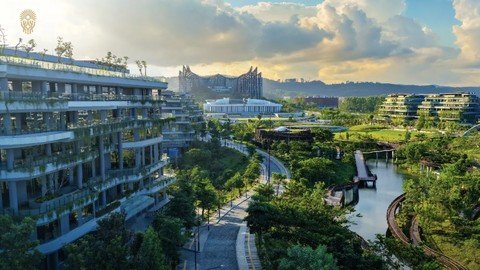
Plaza Seremoni offers an example of that broader transition. Located in front of the State Palace and Garuda Palace, the plaza forms part of the Sumbu Kebangsaan area in Nusantara. It is designed not only for state ceremonies but also as a public space for social, cultural and recreational activities.
Its facilities include an open-air amphitheatre, pedestrian and cycling paths, green areas, an MSME gallery and communal spaces. The combination of functions reflects a wider global movement toward public areas that are designed to accommodate different forms of urban activity rather than serving a single institutional purpose.
The project’s landscape strategy is also notable for its treatment of the existing environment. Rather than relying exclusively on conventional land modification, the design incorporates the site’s natural contours and existing water-management systems. According to the Nusantara Capital Authority, this approach is intended to maintain environmental balance while strengthening the identity of Nusantara as a city developed in harmony with nature.
For Basuki Hadimuljono, Head of the Nusantara Capital Authority, the development of the new capital is guided by three principles: quality, aesthetics and sustainability. The statement provides a concise framework for understanding the broader development philosophy behind projects such as Plaza Seremoni.
These principles are increasingly relevant to the global urban-development industry. As cities face climate pressures, population growth and increasing demand for high-quality public environments, planners and developers are being challenged to integrate ecological considerations directly into urban design.
Nusantara’s forest-city concept reflects this direction. The authority has described the development of the new capital as an effort to combine urban functions with environmental restoration, including approaches aimed at restoring ecological functions and integrating green infrastructure into the city.
The international nature of the MLAA also provides a useful regional perspective. The 2026 awards included landscape projects from Indonesia, Singapore, Thailand and other countries, illustrating how landscape architecture has become a platform for exchanging ideas about public spaces, environmental design and urban resilience across borders.
For the global development industry, the significance of such projects extends beyond architecture itself. Public-space design increasingly intersects with tourism, mobility, local economic activity, community interaction and environmental management. A successful urban space can therefore serve several policy and economic objectives simultaneously.
This is particularly relevant for emerging cities and new urban districts seeking to establish international identities. Design quality can become part of a city’s reputation, while sustainable planning can influence how investors, professionals, visitors and residents perceive the long-term direction of a development.
At the same time, an award is only one point of reference in assessing a city project. Long-term performance will depend on how spaces are maintained, how accessible they remain, how frequently they are used, and whether environmental objectives continue to be achieved as the surrounding urban area grows.
For Nusantara, Plaza Seremoni is consequently both a completed landscape project and part of a much larger urban experiment. Its recognition at MLAA 2026 adds an international dimension to Indonesia’s efforts to develop a new capital that combines government functions with public life and environmental considerations.
The broader lesson for the global urban-development sector is increasingly clear: the future of cities will not be defined solely by the scale of their buildings or infrastructure. The quality of the spaces between those structures, their relationship with nature, and their ability to support everyday human activity will also shape how future cities are experienced and evaluated.