


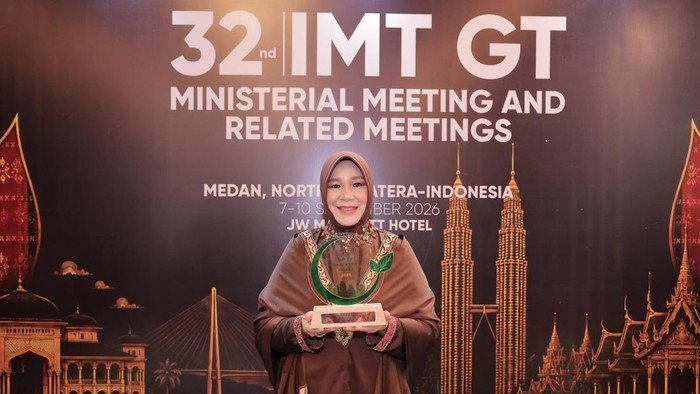
Banda Aceh’s Silver Award at the 1st IMT-GT Green City Award highlights the growing importance of sustainable waste management, collaborative urban governance, and regional knowledge exchange.
Banda Aceh’s recognition at the first Indonesia-Malaysia-Thailand Growth Triangle (IMT-GT) Green City Award illustrates how urban waste management is increasingly becoming a strategic component of sustainable city development. The city received the Solid Waste Management – Silver Award, presented to Mayor Illiza Sa’aduddin Djamal during the Gala Dinner of the 32nd IMT-GT Ministerial Meeting and Related Meetings in Medan on September 9, 2026.
The award placed Banda Aceh among three cities recognised in the Solid Waste Management category. Manjung Municipality in Malaysia received the Gold Award, while Pekanbaru City in Indonesia received the Bronze Award. Rather than functioning solely as a ceremonial distinction, the award provides a regional platform for cities to demonstrate how environmental initiatives can be developed and sustained at the municipal level.
From Waste Management to Broader Urban Performance
The significance of the award lies partly in the way waste management is positioned within the wider sustainable urban development agenda. The official IMT-GT Green City Award framework covers seven areas, including low-carbon mobility, sustainable energy, solid waste management, urban biodiversity, circular economy and resource efficiency, climate governance, and education for sustainable development.
This framework reflects a broader international trend in which cities are increasingly expected to address environmental issues through integrated policies rather than isolated programs. Waste management, for example, is closely connected with resource efficiency, public health, urban resilience, community participation and the long-term quality of urban infrastructure.
The IMT-GT award framework also places emphasis on measurable outcomes. Participating initiatives are required to have been implemented for at least three consecutive years, remain active and demonstrate measurable results. Evaluation considers impact, sustainability, innovation, scalability and adaptability, as well as governance and participation.
For municipalities, such criteria underline an important shift: environmental performance is increasingly assessed not only by the existence of programs, but also by their continuity, measurable results and ability to involve different stakeholders.
Collaboration as a Key Element of Urban Sustainability
Banda Aceh Mayor Illiza Sa’aduddin Djamal described the recognition as both an achievement and a motivation to improve environmental and waste-management performance. She also highlighted the need for participation from government, communities, businesses and other stakeholders, reflecting the increasingly collaborative nature of urban sustainability initiatives.
This approach is particularly relevant to waste management because municipal authorities cannot address the entire waste chain independently. Collection, sorting, reduction, recycling, community behaviour, business participation and public awareness all influence the effectiveness of a city’s waste-management system.
Illiza also framed the award as a challenge for Banda Aceh to continue improving rather than as an endpoint. That perspective is consistent with the IMT-GT framework, which is designed to encourage cities to exchange experiences and develop initiatives that can potentially be adapted or replicated elsewhere in the subregion.
A Regional Platform for Sharing Urban Solutions
The wider importance of the recognition also comes from the role of IMT-GT itself. Established in 1993, the cooperation platform connects provinces and states across Sumatra, Peninsular Malaysia and Southern Thailand, with a vision of developing an integrated, innovative, inclusive and sustainable subregion by 2036. Environment is among its cooperation pillars.
The Green City Award adds a city-level dimension to that regional agenda. Its official framework states that the program is intended to showcase achievements, encourage wider adoption of successful approaches and strengthen city-to-city cooperation through knowledge exchange and replication of best practices.
For Banda Aceh, this creates an opportunity to position its experience within a broader regional conversation on sustainable urban development. The immediate achievement is the Silver Award, but the longer-term value may depend on how the city uses the recognition to exchange knowledge, strengthen partnerships and continue improving its environmental programs.
Local Action with Broader Relevance
The Banda Aceh case also reflects a wider challenge faced by cities across Asia: translating sustainability principles into practical municipal services. Urban populations, consumption patterns and infrastructure demands continue to place pressure on local governments, making effective waste management an increasingly important element of urban resilience.
The IMT-GT Green City Award demonstrates one mechanism for addressing that challenge through regional benchmarking and peer learning. Its connection with the IMT-GT Vision 2036, ASEAN sustainable urbanisation priorities and the United Nations Sustainable Development Goals places municipal initiatives within a broader sustainability framework.
Banda Aceh’s Silver Award therefore represents more than a single moment of recognition. It illustrates how local government initiatives can become part of a wider regional effort to improve environmental governance, encourage collaboration and develop urban solutions that may offer lessons for other cities facing similar sustainability challenges.
For Banda Aceh, the next stage will be to translate recognition into continued performance. As Illiza has stated, the award should serve as motivation to improve waste management and strengthen collaboration across society. In that sense, the value of the recognition will ultimately be measured not by the award itself, but by the continued development of practical, measurable and sustainable urban initiatives.