



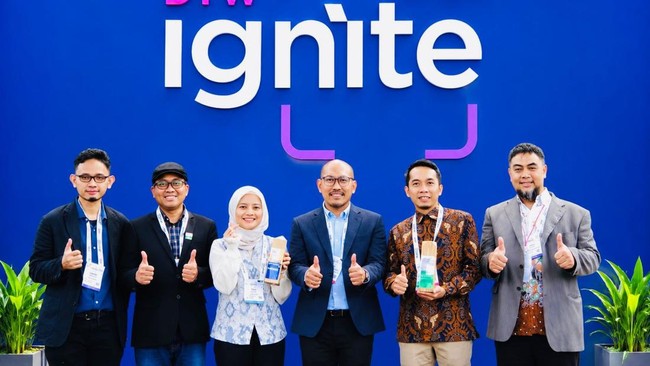
Telkomsel’s three global recognitions at TM Forum DTW Ignite 2026 highlight the accelerating shift toward AI-native networks, autonomous operations and resilient digital infrastructure.
JAKARTA — The telecommunications industry is entering a structural transition. Networks are no longer being designed merely to carry increasingly larger volumes of data; they are gradually becoming intelligent infrastructure capable of detecting problems, interpreting network conditions and automating operational responses.
Telkomsel’s performance at TM Forum Digital Transformation World (DTW) Ignite 2026 offers a useful illustration of that transition. The Indonesian telecommunications operator received three global recognitions at the event in Copenhagen, Denmark, including the TM Forum Excellence Award, a Catalyst Innovation Visionary recognition and Autonomous Network Level 4 (ANL-4) Alpha Validation.
The awards are notable because they span different dimensions of digital transformation. Telkomsel was recognised for an AI-powered early-warning system supporting disaster response and business continuity, for its participation in TM Forum’s collaborative innovation ecosystem, and for progress toward highly autonomous network operations.
Taken together, the three recognitions provide a broader picture of where telecommunications is heading: toward networks that are increasingly AI-enabled, predictive, automated and resilient.
From Connectivity Provider to Intelligent Infrastructure
For decades, telecommunications companies competed primarily on coverage, capacity, speed and reliability.
Those fundamentals remain important. However, the growing complexity of networks is changing the economics of operating them.
Modern telecommunications infrastructure involves enormous quantities of data, multiple network domains, cloud platforms, edge infrastructure, software-defined components and increasingly sophisticated customer requirements.
The traditional model—where human teams monitor large numbers of systems and intervene after problems emerge—is becoming increasingly difficult to scale.
This is why autonomous networks have become a strategic priority for the global industry.
TM Forum describes Level 4 autonomy as a stage in which networks move toward self-optimising, self-healing and increasingly zero-touch operations, with measurable operational outcomes.
Telkomsel’s ANL-4 Milestone
Telkomsel’s ANL-4 Alpha Validation is therefore more than a technical certification.
It signals progress toward a new operating model for telecommunications.
The company has applied AI to service-quality management through its NPS Improvement with AI for Autonomous by TAZ solution. The objective is to enable more automated monitoring and faster responses to potential network issues.
Telkomsel says the achievement makes it the first operator in Indonesia and the third in Southeast Asia to obtain the ANL-4 validation.
The regional significance is substantial. Southeast Asia is experiencing rapid growth in digital services, while operators must simultaneously manage increasingly complex infrastructure and geographically diverse markets.
Greater network autonomy could help operators respond to that complexity without simply scaling human intervention at the same rate.
AI as an Operational Capability
The broader industry evidence suggests that AI is moving beyond experimentation.
TM Forum’s 2026 Excellence Awards specifically highlighted projects that had progressed beyond pilots and proof-of-concepts into production environments with measurable outcomes in areas such as automation, service availability, customer experience, revenue and disaster response.
That distinction is important.
The first phase of enterprise AI adoption was dominated by experimentation: chatbots, predictive models, analytics dashboards and proofs of concept.
The next phase is increasingly about embedding AI directly into operational processes.
In telecommunications, that means AI may eventually influence network planning, fault detection, optimisation, service assurance, customer experience and resource allocation.
Disaster Resilience as a Business Priority
One of Telkomsel’s recognised initiatives demonstrates another important direction: the use of AI for resilience.
Its AI-powered Early Warning System was recognised in TM Forum’s Excellence in People, Profit and Planet category for its role in strengthening disaster response and sustainable business continuity.
The system uses data to identify potential disruptions and support earlier responses.
This is particularly relevant in Indonesia, an archipelagic country exposed to a range of natural hazards.
When telecommunications infrastructure is disrupted during a disaster, the consequences can extend beyond lost consumer connectivity. Emergency communications, coordination between institutions, business continuity and access to information can all be affected.
AI-based early warning therefore represents an intersection between technology strategy and national resilience.
The Economics of Autonomous Operations
The movement toward autonomous networks is also driven by economics.
Telecommunications operators operate capital-intensive infrastructures that require continuous investment and maintenance.
At the same time, customers increasingly expect high availability and rapid service recovery.
Autonomous operations potentially address both pressures.
If AI can identify faults earlier, determine likely causes and trigger appropriate remediation, operators can potentially reduce resolution times and improve resource utilisation.
TM Forum’s 2026 awards highlighted exactly this kind of operational impact, noting that winning initiatives demonstrated tangible gains in areas including fault resolution and reduced operational costs.
The business case for autonomy therefore extends beyond technological sophistication.
It is increasingly about improving the economics of operating complex digital infrastructure.
The Data Foundation
However, autonomous operations cannot be built on algorithms alone.
AI systems depend on data that is accurate, contextualised, accessible and trustworthy.
This is why the global autonomous-network discussion increasingly focuses on the underlying data architecture.
At DTW Ignite 2026, discussions around industry-scale autonomous networks emphasised the need for trusted, contextualised and AI-ready data foundations, alongside measurable business outcomes, organisational transformation and ecosystem collaboration.
For large telecommunications operators, this can be a significant undertaking.
Network information is typically distributed across multiple domains and systems. Integrating those environments while maintaining security and reliability is one of the central challenges of building AI-native operations.
Collaboration Becomes Infrastructure
Telkomsel’s second global recognition—Catalyst Innovation Visionary—highlights another dimension of the transformation.
The company received the recognition alongside Huawei as part of TM Forum’s Catalyst ecosystem. In 2026, TM Forum reported a record 59 Catalyst teams, involving more than 1,350 individuals and 250 organisations, including more than 100 communications service providers.
The scale of participation illustrates a key reality: the future telecommunications architecture is too complex for any single organisation to build in isolation.
AI models, network systems, cloud platforms, cybersecurity tools, data architectures and automation frameworks increasingly need to work together.
Industry collaboration therefore becomes a strategic capability.
The Global Standardisation Dimension
Autonomous networks also raise questions about interoperability.
If every operator develops proprietary approaches to AI-driven automation, the industry could end up with fragmented systems that are difficult to integrate.
This is one reason organisations such as TM Forum play an important role.
Through standards, frameworks and collaborative projects, industry participants can test approaches to interoperability and develop common methods for deploying new technologies.
TM Forum’s Catalyst programme is designed around this principle, enabling members to develop working solutions while testing and advancing industry standards and frameworks.
For operators, participation can provide both technological learning and strategic influence over the standards that will shape future telecommunications ecosystems.
Southeast Asia as a Testbed
The Southeast Asian market provides a particularly interesting environment for autonomous network development.
The region combines highly connected urban markets with remote and geographically challenging communities.
Operators therefore face different network conditions within the same national market.
Indonesia represents an extreme example of this complexity because of its archipelagic geography.
For Telkomsel, AI-enabled network management can potentially help address the scale of that environment by improving the ability to identify and respond to network events across large and diverse areas.
The ANL-4 validation consequently has implications beyond one company. It demonstrates that advanced network autonomy is beginning to move from industry vision toward practical implementation within Southeast Asia.
The Customer Experience Equation
Despite the sophistication of the technology, customers ultimately judge telecommunications companies through relatively simple outcomes.
Does the connection work?
Is the service stable?
How quickly is a disruption resolved?
Can customers depend on the network when they need it most?
This is why autonomous networks should not be evaluated solely by technical autonomy levels.
Their real value lies in translating automation into better customer outcomes.
TM Forum’s autonomous-network agenda explicitly connects Level 4 deployment with measurable progress in fault resolution, operational efficiency, customer experience and service reliability.
AI-Native Networks and the Enterprise Economy
The transformation also extends beyond consumer connectivity.
Enterprise customers increasingly depend on telecommunications infrastructure for cloud access, distributed computing, Internet of Things applications, digital payments, logistics and real-time data services.
As enterprise workloads become more AI-intensive, network requirements are also changing.
TM Forum’s DTW Ignite programme noted that AI-driven workloads, edge intelligence, IoT and multi-cloud enterprise connectivity are pushing networks toward more adaptive and intelligent architectures.
This creates a feedback loop.
AI requires better networks, while AI is simultaneously becoming one of the technologies used to operate those networks.
The result could be a telecommunications sector in which network intelligence becomes a core competitive capability.
The Governance Challenge
Greater autonomy also introduces new risks.
When networks increasingly rely on AI-driven decisions, operators must ensure that those decisions are secure, explainable where necessary and subject to appropriate controls.
This becomes particularly important when AI systems influence critical infrastructure.
The industry therefore faces a balancing act: increase automation while maintaining human oversight, security and accountability.
TM Forum’s broader DTW Ignite programme has placed significant emphasis on trustworthy AI and data alongside autonomous networks, reflecting the understanding that technical autonomy must be accompanied by governance.
Human Skills Still Matter
The emergence of autonomous networks should not be interpreted as the disappearance of human expertise.
Instead, the role of telecommunications professionals is likely to change.
Engineers may spend less time performing repetitive monitoring and more time designing systems, validating AI decisions, managing exceptions and improving network intelligence.
TM Forum’s autonomous-network leadership discussions explicitly identify people, culture, new ways of working and evolving skills as important elements in the transition toward higher levels of autonomy.
The human layer therefore remains essential.
What Telkomsel’s Recognition Means
Telkomsel’s three global recognitions illustrate a company operating across several layers of the transformation.
The early-warning system demonstrates how AI can strengthen resilience.
The Catalyst recognition demonstrates the importance of collaboration.
The ANL-4 validation demonstrates progress toward autonomous operations.
These are not isolated developments.
Together, they form a strategic trajectory from data to intelligence, intelligence to automation, and automation to resilience.
That trajectory mirrors the direction of the wider telecommunications industry.
The Competitive Landscape Ahead
The next stage of competition among telecom operators may therefore be defined by more than network coverage and spectrum assets.
Operators will increasingly need to demonstrate their ability to operate infrastructure intelligently.
The winners may be those capable of combining strong physical networks with advanced software, high-quality data, AI capabilities and effective ecosystem partnerships.
In this environment, network intelligence could become as strategically important as network capacity.
Telkomsel’s progress toward Level 4 autonomy places it among the operators experimenting with that future in practical terms.
From Recognition to Execution
The most important question following the Copenhagen recognitions is what happens next.
An award or validation establishes external recognition, but sustainable competitive advantage depends on continued execution.
Telkomsel will need to expand the use of AI across relevant network domains, strengthen its data foundations, maintain cybersecurity and demonstrate measurable benefits at scale.
The company will also need to ensure that automation remains aligned with customer needs and operational reliability.
That is the difference between an innovation programme and a transformation strategy.
A Broader Global Signal
Telkomsel’s achievements at DTW Ignite 2026 are ultimately part of a much broader global transition.
TM Forum’s Excellence Awards show that AI, autonomy and composable architectures are moving into real-world telecommunications operations. Its Catalyst programme shows that collaboration is accelerating the development of working solutions.
The implications extend well beyond telecom operators.
More intelligent networks will influence enterprises, governments, cloud providers, technology vendors and consumers.
As connectivity becomes increasingly embedded in economic activity, the intelligence and resilience of the underlying network infrastructure will become an increasingly important part of digital competitiveness.
Conclusion
Telkomsel’s three global recognitions at TM Forum DTW Ignite 2026 offer more than a snapshot of corporate achievement. They provide an indication of how the telecommunications industry is evolving.
The sector is moving toward networks that can increasingly predict, decide, optimise and respond.
AI-powered early warning systems show how intelligence can strengthen resilience. Catalyst collaboration demonstrates how industry partnerships can accelerate innovation. Level 4 autonomous-network validation illustrates how network operations are moving toward greater autonomy.
For Indonesia, the development reinforces the country’s position as an important digital market in Southeast Asia.
For the global telecommunications industry, it demonstrates that the transition toward AI-native infrastructure is becoming increasingly practical.
And for Telkomsel, the three recognitions represent not an endpoint, but another milestone in a much longer transformation—from a conventional connectivity provider toward an increasingly intelligent digital infrastructure company.
Sources
CNN Indonesia — Telkomsel Raih Tiga Pengakuan Global di TM Forum DTW Ignite 2026