


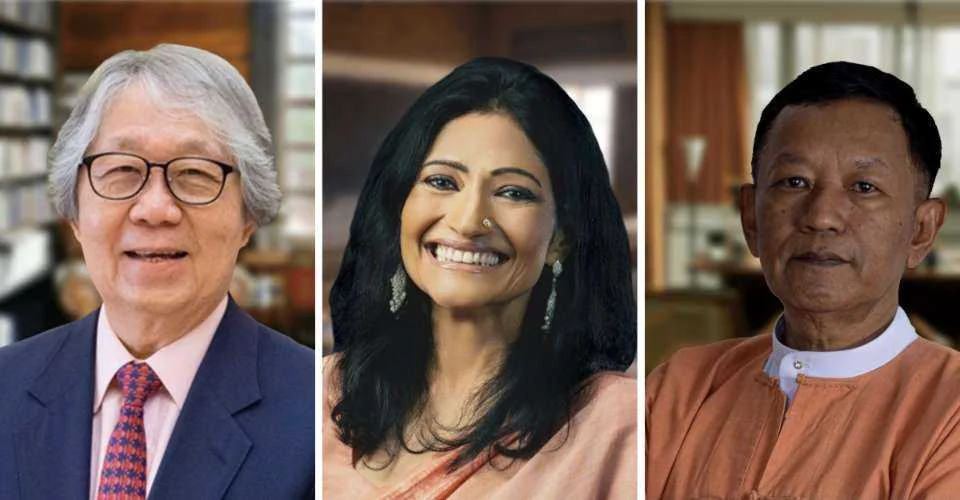
Tommy Koh, Runa Khan, and Bo Kyi receive the 2026 Ramon Magsaysay Award for contributions to diplomacy, humanitarian service, human rights, and transformative leadership across Asia.
The 2026 Ramon Magsaysay Award has recognized three figures whose work represents different but interconnected dimensions of leadership in Asia: Singaporean diplomat and legal scholar Tommy Koh, Bangladeshi humanitarian and social entrepreneur Runa Khan, and Myanmar human rights advocate Bo Kyi. The three were announced as this year’s recipients on August 31, with the award foundation highlighting their commitment to public service, human dignity, and solutions to complex social challenges.
The Ramon Magsaysay Award remains one of Asia’s most prominent recognitions for transformative leadership. Established in 1957 and first presented in 1958, the award honors individuals and organizations demonstrating what the foundation describes as “greatness of spirit” through selfless service to Asian communities. With the 2026 recipients, the total number of laureates reaches 359, comprising 331 individuals and 28 organizations from 24 countries and territories.
Tommy Koh: Diplomacy as a Long-Term Investment
Tommy Koh represents the diplomatic and institutional dimension of the award. The 88-year-old Singaporean diplomat, lawyer and academic has spent decades working in international diplomacy and law. He played a major role in the negotiations that eventually produced the United Nations Convention on the Law of the Sea (UNCLOS), a landmark framework governing maritime activities and international disputes.
Koh’s recognition also illustrates the continuing importance of dialogue in an increasingly fragmented international environment. His career demonstrates how diplomacy can produce lasting institutions and agreements rather than merely short-term political compromises. His work has extended beyond international negotiations into education and institution-building in Singapore.
For the wider Asian region, this experience is particularly relevant. Maritime boundaries, trade routes, environmental concerns and geopolitical competition continue to require mechanisms that encourage countries to negotiate rather than escalate disagreements. Koh’s career therefore provides a model of leadership built around international law, patience and cooperation.
Runa Khan: Innovation for Climate-Vulnerable Communities
Runa Khan brings another dimension to the 2026 award: humanitarian innovation. Through Friendship, the organization she founded in Bangladesh, Khan has developed programs aimed at communities that face geographical isolation, flooding, river erosion and the growing effects of climate change. Its work includes healthcare, education, livelihoods and climate-adaptation initiatives.
Friendship’s approach illustrates a broader trend in international development: humanitarian organizations are increasingly required to adapt their delivery models to communities affected by environmental disruption. In Bangladesh, where river systems and coastal conditions can rapidly alter settlements, conventional fixed infrastructure may not always be sufficient. Khan’s work has included mobile and relocatable services designed around those realities.
This model has implications beyond Bangladesh. Climate vulnerability is becoming a major development issue across Asia, affecting food security, health, migration, infrastructure and economic opportunity. The recognition of Khan signals the growing importance of organizations capable of combining humanitarian assistance with long-term resilience.
Bo Kyi and the Human Rights Dimension
Myanmar activist Bo Kyi represents the human rights and civic-resilience dimension of this year’s award. A former political prisoner, he co-founded the Assistance Association for Political Prisoners (AAPP) in 2000 after leaving Myanmar. The organization has documented political arrests and detention while supporting prisoners and their families.
The significance of this work has become even more pronounced following Myanmar’s 2021 military coup. As political repression intensified, documentation and assistance for detainees became increasingly important for families, civil society organizations and international observers seeking reliable information about human rights conditions.
Bo Kyi’s recognition demonstrates that leadership in Asia is not limited to government, business or formal institutions. It can also emerge from civil society, particularly from individuals who transform personal experiences of hardship into sustained efforts to protect others.
Three Models, One Regional Message
Although Koh, Khan and Bo Kyi operate in very different fields, their recognition reflects a common trend in contemporary Asian leadership: the shift from leadership based primarily on position toward leadership measured by impact. Diplomacy, humanitarian development and human rights advocacy may appear separate, but each ultimately seeks to create systems that protect human dignity and expand opportunities.
The award also comes at a time when Asia faces overlapping challenges, from geopolitical tensions and climate change to inequality, displacement and political instability. The three laureates demonstrate different responses to these pressures: building international rules, designing adaptive humanitarian services and protecting vulnerable communities through documentation and advocacy.
Their stories therefore offer lessons for governments, businesses, civil society organizations and international institutions. Sustainable progress increasingly depends on collaboration across sectors, long-term thinking and the ability to develop solutions suited to local circumstances.
The formal presentation of the 2026 Ramon Magsaysay Award is scheduled for November 15, 2026, at the Metropolitan Theatre in Manila, where the recipients are expected to receive the official medallion and certificate.
A Broader Global Impact
The significance of the 2026 Ramon Magsaysay Award extends beyond the three individuals themselves. Their careers demonstrate how Asian-led solutions can contribute to global discussions on international law, climate adaptation, humanitarian development and human rights.
For the international community, the message is clear: some of the most consequential forms of leadership are built gradually through institutions, communities and persistent service. Tommy Koh’s decades of diplomacy, Runa Khan’s humanitarian innovation and Bo Kyi’s commitment to political prisoners each represent a different pathway toward meaningful social change.
As Asia continues to experience rapid economic, demographic and environmental transformation, these models of leadership could become increasingly relevant. The 2026 laureates show that regional progress does not have to come from a single formula. It can emerge through diplomacy, innovation, advocacy and an enduring commitment to human dignity.