

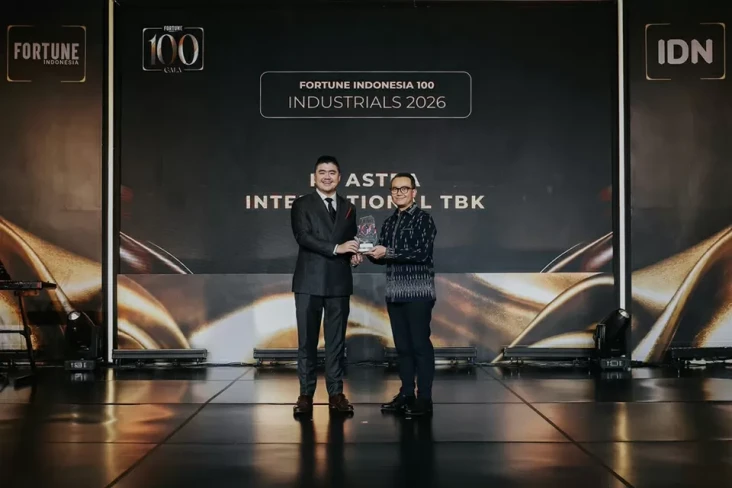
Astra’s fourth-place ranking in Fortune Indonesia 100 2026 highlights the scale of Indonesia’s corporate sector, while its 2026 strategy reflects changing industrial and economic conditions.
JAKARTA — PT Astra International Tbk has once again secured a position among Indonesia’s largest companies, ranking fourth in the Fortune Indonesia 100 2026. The recognition comes at an important point in the company’s corporate journey as Astra prepares to enter its seventh decade while navigating changes across automotive, financial services, mining, heavy equipment and other industries.
The company also received the Fortune Indonesia Outstanding Growth 2026: Biggest Company by Total Employees award. Astra currently has more than 190,000 employees and 324 subsidiaries, joint ventures and associates, making its organizational scale one of the defining characteristics of the group’s position in Indonesia’s economy.
The Fortune Indonesia 100 ranking is based on audited financial statements for the 2025 financial year. Its methodology considers several indicators, including revenue, net profit, total assets, equity and market capitalization. Astra’s fourth-place position therefore provides an indication of the company’s financial and economic scale within Indonesia’s corporate landscape.

Yet the significance of Astra’s latest recognition is better understood when viewed alongside the broader performance of its businesses. The group generated consolidated net revenue of Rp323.4 trillion in 2025, while net income reached Rp32.8 trillion, a 3% decline from the previous year. Financial Services recorded 9% net-income growth, while the Heavy Equipment, Mining, Construction and Energy division declined 24%.
The divergence continued into the first half of 2026. Astra reported consolidated net revenue of Rp157.9 trillion, down 3% year on year, while net income excluding non-recurring items fell 7% to Rp14.9 trillion. Reported net income declined 19% to Rp12.5 trillion. The results reflected different conditions across Astra’s business portfolio rather than a uniform movement across the group.
Automotive and Financial Services provided stronger contributions during the period. Automotive net income increased 9% to Rp5.9 trillion, supported by higher new-car sales and stronger contributions from the components business. Financial Services increased net income by 6% to Rp4.6 trillion, supported by growth in consumer financing and insurance activities.
Mining and heavy equipment, meanwhile, faced more challenging operating conditions. Net income from the segment, excluding non-recurring items, declined 46% to Rp2.7 trillion. Astra attributed the decline to lower gold production and sales, reduced heavy-equipment demand and lower activity in mining services and coal mining, including the effects of lower national coal production allocations.
These contrasting results illustrate a broader feature of diversified corporate groups: portfolio breadth can provide multiple sources of earnings, but it also exposes companies to different economic cycles and commodity, consumer and regulatory conditions. Automotive demand, consumer financing, mining activity and commodity prices can move independently, requiring different operating and capital strategies.
Astra has responded by sharpening its corporate direction. Its 2026 Strategy Roadmap places greater emphasis on three core businesses—Automotive, Financial Services, and Mining Solutions & Heavy Equipment—while adopting a clearer framework for businesses outside the core portfolio. The strategy is built around four principles: Focus, Clarity, Discipline and Commitment.
Capital allocation has also become a more explicit component of the strategy. Astra announced a new share buyback program of up to Rp8 trillion over 12 months, while United Tractors announced a separate program of up to Rp2 trillion over three months. The company has said the broader strategic framework is intended to support sustainable shareholder returns while maintaining financial resilience.
For international observers, Astra’s development also provides a useful lens into Indonesia’s increasingly diversified private sector. The company operates across industries that are closely connected to economic development, including mobility, consumer finance, industrial equipment, mining, infrastructure, agribusiness, information technology and property. Its activities therefore intersect with several major themes shaping emerging-market economies: urban mobility, industrial investment, digital transformation, commodity cycles and access to financing.
Human capital represents another dimension of Astra’s scale. With more than 190,000 employees, maintaining organizational capability across multiple industries requires structured approaches to leadership, skills development and workplace culture. Astra’s People Roadmap focuses on a safe, inclusive, collaborative and sustainable working environment while strengthening employee capabilities and leadership development.
The company’s sustainability activities also extend beyond its commercial operations. Astra reports that its Desa Sejahtera Astra program has reached more than 1,500 villages across 35 provinces, with initiatives covering health, education, environment and entrepreneurship. Since 2010, its SATU Indonesia Awards program has also recognized hundreds of young Indonesians contributing to their communities.
The combination of corporate scale, diversified operations and strategic repositioning comes as global businesses face a more complex operating environment. Commodity volatility, shifting consumer behavior, technology adoption, capital costs and evolving sustainability expectations are influencing how large corporations allocate resources and manage long-term growth.
Astra’s latest Fortune Indonesia 100 recognition therefore represents more than another corporate accolade. It provides a snapshot of a large Indonesian business group at a transitional point: financially significant, deeply diversified and supported by a workforce exceeding 190,000 people, while simultaneously reassessing how its portfolio should be positioned for the next phase of growth.
As Astra moves toward seven decades of operations, its experience reflects a broader question facing large companies in emerging markets: how to preserve the advantages of scale while remaining sufficiently focused and adaptable in a rapidly changing economic environment. The company’s current strategy suggests that portfolio discipline, operational resilience, human-capital development and long-term value creation will remain central to that process.