


Jababeka Bizpark wins the Indonesia Property Award 2026, highlighting the growing role of flexible business space, industrial connectivity and integrated ecosystems in supporting business expansion.
CIKARANG, Indonesia — The changing structure of industrial and commercial activity is reshaping the role of business property. For companies operating in increasingly dynamic markets, a business facility needs to accommodate more than a single function. Storage, production, distribution and commercial activities can increasingly intersect within the same operating environment.
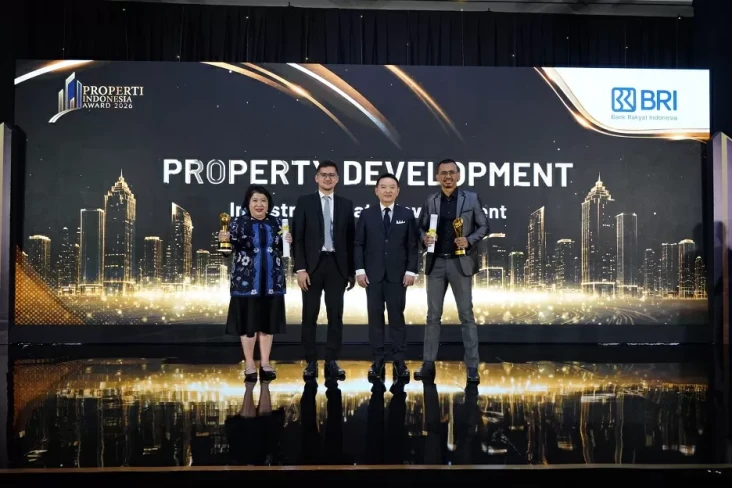
This shift provides the context for the recognition received by Jababeka Bizpark, a project developed by PT Graha Buana Cikarang, a subsidiary of PT Jababeka Tbk. The project won the Indonesia Property Award 2026 in the Property Development category, under the Industrial Estate Development subcategory. The award was presented at JW Marriott Hotel Jakarta on August 26, 2026.
The award comes as demand for flexible business space grows within Kota Jababeka. According to Jababeka, the potential market is not limited to newly established businesses. Companies already operating within the Jababeka area may also require additional space as they expand their operations or develop new business activities.

Jababeka Bizpark was developed to address that requirement through a multipurpose building concept. Its facilities can accommodate storage, production, distribution and commercial activities, while its high-ceiling configuration allows users to expand the internal space to as many as three floors, depending on their needs.
The flexibility is significant because business expansion does not always follow a linear model. A company may initially require a relatively compact operational facility before adding inventory, production capacity, distribution activities or commercial functions. A property capable of adapting to those changes can therefore become part of a company’s longer-term operating strategy.
From Property Product to Business Infrastructure
Jababeka’s approach places the Bizpark concept within a larger ecosystem rather than treating the project as an isolated property development. Kota Jababeka has evolved for more than three decades into an integrated township combining industrial, business, residential and educational activities with supporting facilities. The area is currently home to more than 2,000 companies and around 1.2 million people.
Connectivity adds another layer to that ecosystem. Kota Jababeka is supported by four toll-road accesses and the Cikarang Dry Port, providing infrastructure relevant to industrial and logistics activities. For businesses managing the movement of goods and materials, the combination of industrial concentration and transportation infrastructure can become an important consideration when determining an operating location.
The development of flexible business space also reflects the diversification taking place within industrial areas. Traditional industrial estates have historically been associated primarily with manufacturing and industrial land. As business models become more integrated, however, warehouses, distribution facilities, commercial spaces and multipurpose buildings can become complementary components of the wider industrial ecosystem.
This broader development is also visible in Jababeka’s market outlook. ANTARA reported in March 2026 that PT Jababeka Tbk targeted marketing sales of Rp3.75 trillion for 2026, compared with Rp3.2 trillion in 2025. The company said the target was primarily supported by continuing demand for industrial land in Kendal and Cikarang.
For the property sector, the figures provide a broader indication of continued activity in Indonesia’s industrial real-estate market. They also illustrate why the development of supporting business spaces can be relevant alongside larger industrial land offerings.
Flexibility as a Competitive Factor
Jababeka Bizpark’s design reflects the idea that flexibility can become a competitive factor in business property. Instead of prescribing a single use, the multipurpose configuration gives users the possibility of adapting the space to their operational requirements.
This approach also corresponds with the development’s progress in the market. In April 2026, Jababeka completed the simultaneous handover of Phase I Bizpark units to customers. The company highlighted the combination of strategic location, competitive pricing and building-design flexibility as part of the product’s value proposition.
From an investment perspective, Jababeka Bizpark is offered starting at IDR 1.65 billion, with financing alternatives supported through partnerships with several banks. This positions the development within a segment that can be relevant to entrepreneurs, business owners and investors seeking commercial property within an established industrial environment.
Ivonne Anggraini, Director of PT Graha Buana Cikarang, has described the development philosophy as extending beyond the physical building. In Jababeka’s view, property should connect with the surrounding ecosystem, infrastructure and opportunities for business growth.
That perspective is increasingly relevant as companies evaluate property decisions through a wider set of considerations. Location, connectivity, operational flexibility, access to business networks and proximity to supporting infrastructure can all influence how a facility contributes to an organization’s expansion strategy.
The Wider Industrial Property Landscape
The recognition of Jababeka Bizpark also illustrates a broader evolution in industrial property. Business users are increasingly looking for spaces that can accommodate multiple stages of their operations rather than facilities defined by a single purpose.
For established industrial clusters, this creates opportunities to develop complementary property products around existing manufacturing and logistics activities. A mature ecosystem can support not only factories and industrial land, but also distribution, storage, commercial activities and services that help businesses operate within the same geographical network.
Kota Jababeka provides an example of that integrated model. Its combination of companies, infrastructure, human resources and supporting facilities creates an environment in which business-property developments can be connected to a wider economic ecosystem rather than operating independently.
The Indonesia Property Award 2026 therefore represents more than a milestone for an individual property project. It also places Jababeka Bizpark within the continuing evolution of industrial and commercial real estate, where adaptability and ecosystem connectivity are becoming increasingly important considerations.
As companies continue to adjust their operating models, the relationship between property and business strategy is likely to remain an important part of the industrial real-estate landscape. Jababeka Bizpark’s development demonstrates one response to that shift: combining flexible physical space with access to an established industrial ecosystem and supporting infrastructure.